
Santorini is the ultimate destination for relaxation, recuperation and revival – the perfect place to press pause.
Anna Price
In many of 2019’s travel guides, Greece is the ideal getaway location. This European hot-spot is a crowd-pleaser: accommodating for families but perfect for the romance-seekers. Santorini epitomises this idyllic Grecian getaway as it sits deep in the Aegean Sea, encircling a dormant volcano and the surrounding Caldera. Santorini exudes peace and luxury, avoiding the party vibe of other islands and with fewer all-inclusive resorts but more boutique hotels, the island is inviting and calm.


Santorini’s aesthetic of serenity derives from the azure skies and the cerulean sea. The combination of these cool blues with the stark white, stone buildings of the towns is striking and artistic. Wandering through the coastal towns is peaceful; even under the beating sun, the towns’ smooth appearances are gentle and serene.
In the height of summer, however, this stillness dissipates due to the influx of tourists travelling from skies and far off seas. Cruise ships’ en-masse, slow-walking, guided troupes render it difficult to absorb the natural peace of the island, while meandering the narrow, stoney streets along with fifty other English-speaking travellers tends to detract from the state of inner-calm.
This tourist-invasion can be avoided, nevertheless, by travelling towards the beginning, or end, of the season. At this time, there are fewer families and generally fewer visitors. Furthermore, the end-of-season weather is more manageable at 22 degrees celsius (as opposed to 35 in the midst of summer), even if the rain showers may be unpredictable. With cooler temperatures and less people, the opportunity to enjoy and absorb the expansive views is more likely in March/April and September/October.

Santorini was once one whole island, called Stongili, meaning round. However the volcanic eruption in 1500 BC sank the centre of the island, breaking the island apart and forming the infamous Caldera. It is thought that this geological event, along with the buried town of Akrotiri, inspired the myth of Atlantis. Akrotiri is a town towards the south of Santorini, and the site of a major archeological excavation, due the fact that Akrotiri was buried by the ash of the volcanic eruption. Akrotiri is still being excavated and preserved today and allows visitors to walk in and around the ancient paths and houses, discovering the artefacts and murals. The archeological site is extraordinary, and a fantastic sight-seeing destination providing context and understanding of how the island of Santorini came to be today.
A short walk down to the coast from Akrotiri is a small row of restaurants resting directly on the sea front. Here finds ‘The Cave of Nikolas’, a local-recommended taverna with traditional seafood and a welcoming atmosphere. The dining experiences on the island vary in terms of price and style, although most serve the traditional Greek cuisine of mezze boards, moussaka and gyros. There are options for fine dining, however, and we returned to Lauda, in Oía, twice for cocktails and once for their fine dining menu. Lauda’s fine dining is impressively good: creative and well-crafted with excellent Grecian wine pairings, as well as the absolutely stunning sunset views. The Fish Tavern in Ammoudi Bay is on the other end of the spectrum, while the food is still delicious, the atmosphere is more relaxed and the service is rustic. We had to haggle for our fish.


While Thira is the liveliest town for nightlife, Oía is the destination for sunset-watching and expensive shopping. It is possible, and highly recommended, to hike between the two towns – proper shoes and semi-sportswear are required for this, however, as the ground is uneven and the hills are steep. Imerovigli is situated between the two towns and provides the perfect cafés for refreshments mid-hike.
To stay in Santorini, but not have a hotel that overlooks the Caldera, would be regrettable. The Caldera-facing towns are populated by fondant-icing style buildings that drip off of the cliff – quite the architectural feat – along with steep, winding steps that make it quite difficult to wield a suitcase. The porters at these cliff-side hotels are impressively adept at shoulder-carrying luggage of any size down such steps but the hotels themselves tend to be over-looked by passers-by. The hotel pools, sun-beds, bar and restaurant areas can be seen by walkers meandering through the villages, as the buildings themselves are vertically spread across the cliff-face, almost merging into each other. This creates a lack of privacy that I personally find off-putting.
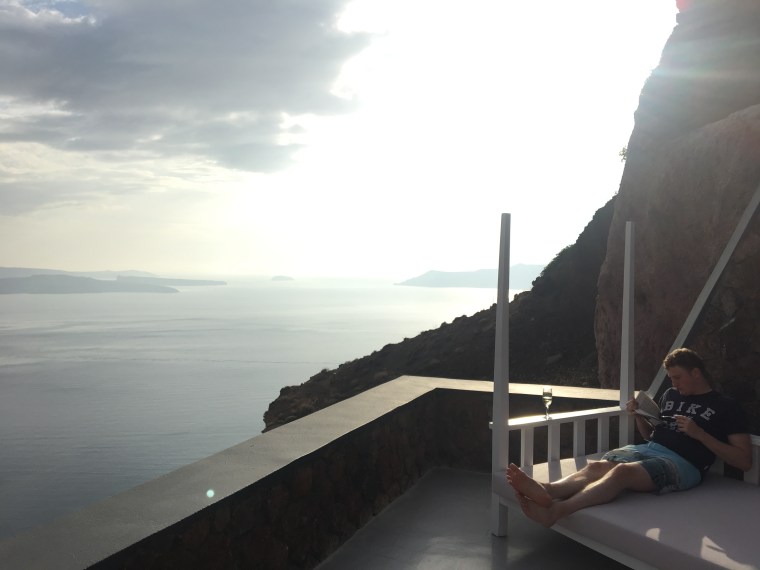
Nevertheless, located on the hiking path between Imerovigli and Oía, is San Antonio Suites. This hotel is set deep in the cliff, with clear, unprecedented views of the Caldera, luxurious rooms and outstanding service. The privacy level is perfect and the atmosphere is of serene elegance. San Antonio Suites is indulgent without being ostentatious; a fine line they navigate perfectly. The stay at this luxury hotel is unique and memorable: the private terraces and hot tubs provide a sense of exclusivity, furthered by the intimate bar seats looking out to sea, and the options for private spa afternoons. The positioning in the cliff creates a seclusion that also protects from large gusts of wind but retains the warmth of the sunlight. Walking into this hotel is like entering your own section of the island and with less than thirty rooms, the public spaces rarely feel crowded. There is nothing better than privately soaking up the evening sun, champagne in hand, overlooking the ocean. It is the ultimate escape.
By the end of the Santorini experience, sun-soaked and full of taramasalata, visitors feel replenished in mind, body and soul. The views are constantly breath-taking and automatically fill you with serenity. Santorini reminds us of the importance of simplicity and the wonder that lies in natural beauty. This island allows you to take a step back, relax and breathe.
All pictures are my own unless otherwise credited. Permission must be obtained before any reproduction and credit must be issued in any reproduction.



 Under The Cypress Tree