

A New York Times number one bestseller, Wild maps an autobiographical journey on the Pacific Crest Trail for self-acceptance, redemption and hope in order to tackle grief, loneliness and fear.
Cheryl Strayed loses her mother after a short but severe fight with cancer, contact with her close family dissipates and she separates from her husband and starts a downward spiral of drugs, sex and part-time waitressing. In need of an escape, and a means back to herself, Strayed takes on the PCT at the confusion of her close friends and with minimal training.
With boots too big, a “Monster” of a pack and the simple resolution to keep putting one foot in front of another, Strayed commences the trail and proceeds to trek through scorching 100 degree heat, vast terrains and stacks of compacted snow. Relationships are formed with inanimate objects: her pack, her tent, and her equipment become her comrades, while William Faulkner, Adrienne Rich, Flannery O’Connor, James Joyce and J.M. Coetzee offer companionship and support in her quest to keep moving forward. While she encounters snakes, bulls, a potential rapist and occasionally the other hiker, Strayed convinces herself that she is not afraid. She trains her mind to think that she is safe, and this in turn spurs her strength, perseverance and sense of belonging:
“Every time I heard a sound of unknown origin or felt something horrible cohering in my imagination, I pushed it away. I simply did not let myself become afraid. Fear begets fear. Power begets power. I willed myself to beget power” (p. 51).
While current meditation techniques encourage an acceptance of all thoughts and emotion, Strayed’s strength of mind to avoid fear and to convince herself that she is unafraid is empowering and poignant. Coinciding with Adrienne Rich’s poem: ‘Power’, there is a repetitive rhythm to the solitary nature of the trail, spurring Strayed’s self-encouragement, understanding and eventual self-affirmation.
This text is not afraid to divulge the challenges of the trail: the mental strain, the damage to the body (losing toenails and never-healing scars), the perpetual stickiness of sweat and matted hair. These elements are not glorified, and they are not appealing, but the sense of peace, accomplishment and primitive joy that emerges in snippets throughout the book are immense encouragements for the reader to get up, go out and enjoy the outdoors.
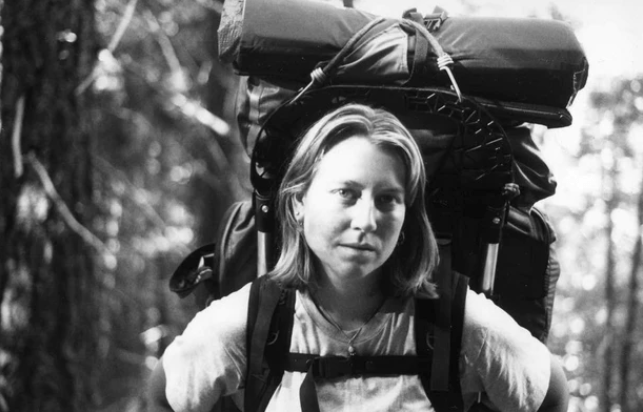
Strayed’s unpreparedness for the trail is appealing to the average reader and allows for comedy as well as sympathy. Her mishaps, including her low average of 9 miles a day, render the text realistic and accessible, as they reveal her raw imperfections. This honesty draws in the reader and allows them to appreciate Strayed as a writer, as a trekker and as a woman. In spite of her adversities, however, Strayed is no stranger to nature: she grew up in rural Minnesota with a focus on freedom, living off the land and happiness. She has a knowledge of flowers and plants, and enjoys outdoor activities – a trait descended and ingrained from her mother. This love of nature is, after all, why she decided to return to it in order to find herself.
The description of Strayed’s epic quest runs alongside a counter-narrative that divulges stories from her childhood, the event of her mother’s illness and death, her relationships and infidelities and her dabbles with hard drug use. This counter-narrative, understandably, is not communicated chronologically; but it does provide a sense of confusion regarding the details of her past. The events leading up to Cheryl’s decision to hike the PCT, and then her preparation in advance of her actually starting the trail are obscured – there is a lack of clarity in the explanation of her preparation process, both mentally and physically. Then again, this is not a travel guide; it is a travel book. The important themes and motifs that arise in this segmented narrative are apparent and provide the reader with substantial information that allows them to understand Strayed’s character and her motives while on the trail.
Strayed’s novel is comedic and raw. The battle with bereavement is handled with honesty and care, while the quest for self-acceptance is empowering. The syntax is at times convoluted, but the language used is apt and the overall structuring works well. This book offered an escape from day to life, it was educative and inspiring: a fabulous must read.


All pictures are my own unless otherwise credited. Permission must be obtained before any reproduction and credit must be issued in any reproduction.
 Under The Cypress Tree