The Amalfi Coast is iconic: silk scarves, winding roads, lemons, plunging cliffs, olive oil, multi-coloured pastel architecture with the shadow of Sophia Loren catching your eye at every corner. It emanates glamour and luxury: the scent of summer romances from bygone eras float on the sea breeze while Mount Vesuvius ominously punctuates the expansive blue skyline.
The Amalfi Coast is Italy’s counterpart to France’s Côte D’azur; it sparkles with subtle sophistication, with less of the glitz and showbiz of the French Riviera. That’s not to say that this isn’t a secret hotspot of celebrity holiday-makers, The Amalfi Coast is known to have appealed to society’s high and mighty for years. From being a stop on the European Grand Tour in the early 1800s and attracting Royal getaways, to harbouring author retreats and silver screen icons’s secluded escapes.
I feel like I am writing this blog in a strange, futuristic universe as we are still in the midst of a world-wide pandemic. In the UK, we’ve been on lockdown for approximately six months, and our society is starting to open up. International travel is still a gamble, however, as you could be subjected to quarantine at short notice on either side.
To beat the travel blues, I am therefore transporting myself back to April 2019, where we visited the secluded splendour of the Amalfi Coast, in particular, Sorrento.
Sitting atop a drastic cliff-edge, this small harbour town is a popular destination with week-long holidayers, Europe-tourers and cruise ship day-trippers alike. For this reason, the small Sorrento centre is often crowded with people exploring the café-lined main square or picking up local custom with an evening passeggiata.
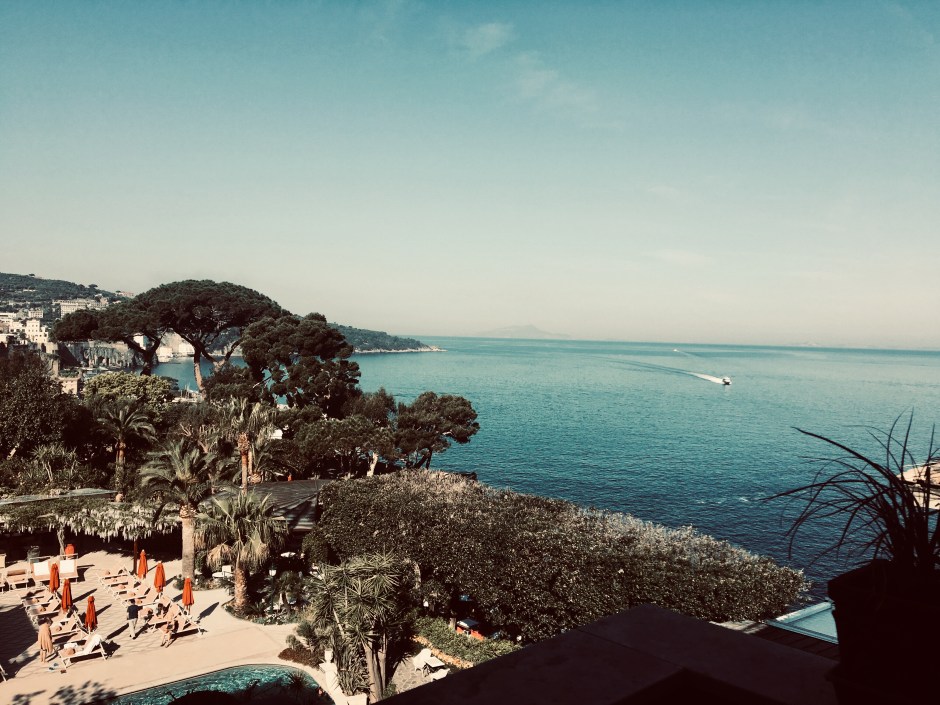
Hotels in and around Sorrento are luxurious. A welcome recluse from the busy streets, they offer a peaceful sanctuary to soak up the sun. We took our respite in Grand Hotel Ambasciatori; with marbled floors, white, pillared walls and floor-to-ceiling windows overlooking the cliff-drop and expansive mediterranean sea, this hotel harks back to a time of nineteenth-century travel grandeur. It is reminiscent of the height of Victorian travel fashion, and the ghosts of full-skirted ladies and cigar-smoking men linger in the air. Imagine Lord Byron lounging in the corner, the ladies from Tissot’s The Ball on the Dockyard bustling through the foyer or Little Women’s Amy taking tea with Aunt Marge in the conservatory.


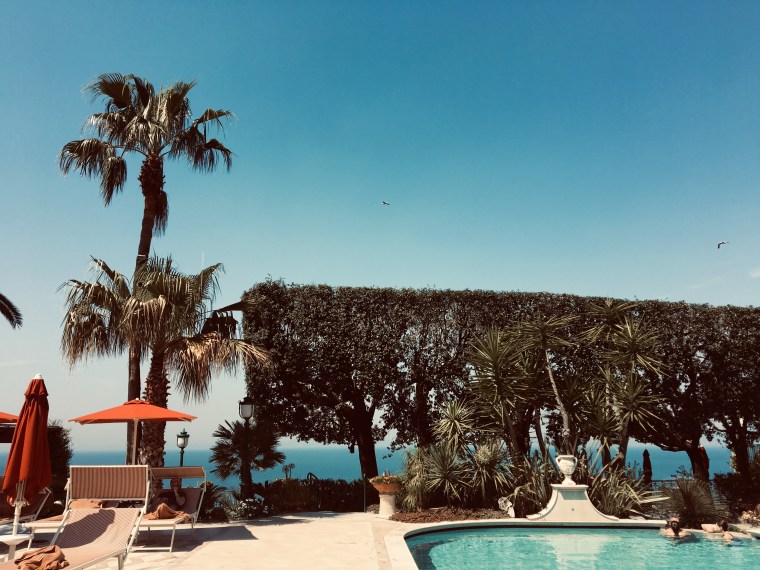
The outside gardens of Hotel Ambasciatori move away from the classic 19thC feel, as the red parasols, terracotta coloured building combined with the palm trees and cobalt-blue pool are distinctly more Hollywood glamour. The whole garden landscape, stone walkways, secluded seated areas and rows of coral-pinstriped deckchairs scream LA sophistication.
Visiting in April meant that we caught the end of the off-season. The hotel was peaceful but expansive, meaning it did felt a little empty. But this spacious atmosphere was actually perfect: it’s easy to imagine that every seat, table and outside lounge chair would be filled in peak summer and this spring quietude was no bad thing. We were able to amble at pleasure, absorb the views unhindered by other families and we weren’t restricted to dining times.


Sorrento is a small town, and for the well-seasoned tourist can be absorbed in a day, or even an afternoon. The Correale di Terranova museum is worth a visit for those desiring a culture fix. It boasts traditional Italian decorative arts, various sculptures and a garden path that runs alongside a lemon vineyard. Chiostro di San Francesci, however, is perhaps more interesting. One of the oldest monuments in Sorrento, this cloister is a medieval (14thC) monastery and is now considered to be the art centre of Sorrento.
The defining arches of the cloister are reminiscent of the architectural designs of Florence, while the stone steps take you up two small stories and lead to an exhibition space as well as a panoramic veranda overlooking both the town and the Mediterranean sea.
Off the south-western point of the Italian mainland coast is the Island of Capri and Anacapri. Capri is renowned for its wealth: designer shops, over-priced drinks, small winding, stone footpaths and many, many tourists. It certainly feels more like an attraction than a place, and I can’t help but think it must be a strange place to live.
We visited Capri as part of a day’s private boat tour – allowing us to take in the coastal sites, explore the sea-level grottos, and enjoy time on the water. Something about setting off in the early morning sun, cutting through the bright blue water and being able to admire Sorrento from the sea was particularly refreshing. Somehow it doesn’t quite feel like a holiday until you’ve spent a day at sea, as it were.


Mount Vesuvius is the dominant skyline feature from all points of Sorrento and it is impossible to ignore. It is a striking reminder of the devastation that ensued in 79AD, and waking up to it every morning, as well as visiting the sites of Pompeii and Herculaneum, render the story of its eruption less a myth-like story taught in schools, and more a concrete element of our western history.
Pompeii and Herculaneum are towns perpetually frozen in time: their art, architecture and even people have been preserved for us all to see. It is a window into the heart of Ancient Roman and it is concurrently extraordinary, magnificent and terrifying. Understanding how these ancient Romans lived, how and why they constructed their towns and feeling their fear at this apocalyptic event is quite remarkable.


With the close access to this history at Pompeii, as well as the culture of Capri, Sorrento works as the foundation for exploration further afield. Road trips further along the Amalfi coast could have been possible, or an expedition to the ancient Greek city of Paestum, or perhaps a stop-over on the low-key island of Ischia.
As I think back to Sorrento’s sunshine filled streets, the winding cliff-side roads, the ginormous lemons and the expansive blues where sea meets skies, I feel that travel bug itch and I can’t wait to visit somewhere new, feel the freshness of foreign sea air and explore old town streets, ice cream in hand, once more.
All pictures are my own unless otherwise credited. Permission must be obtained before any reproduction and credit must be issued in any reproduction.
 Under The Cypress Tree