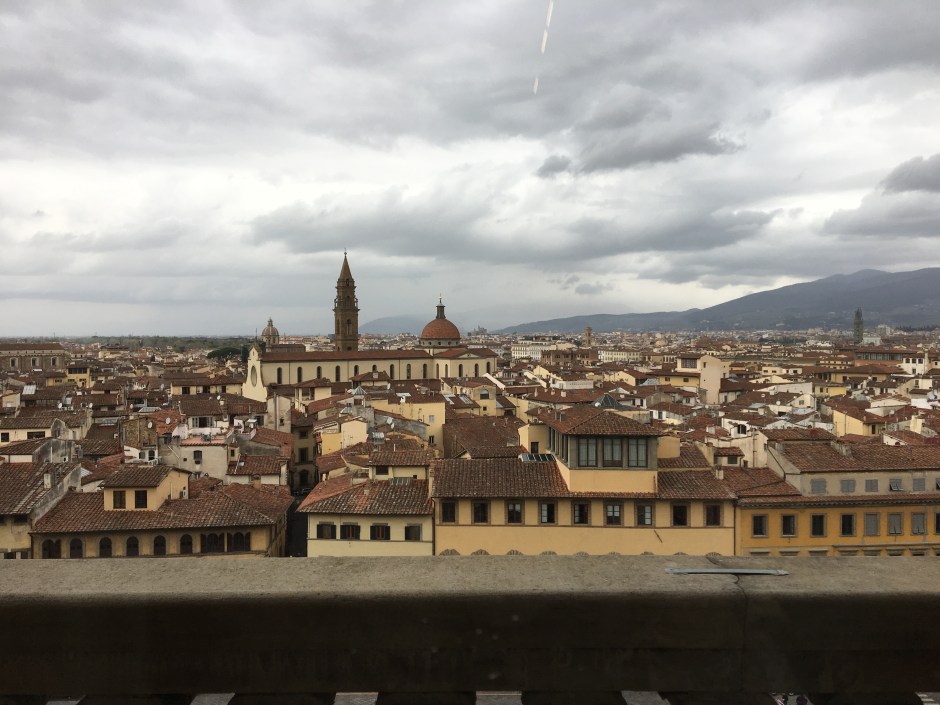
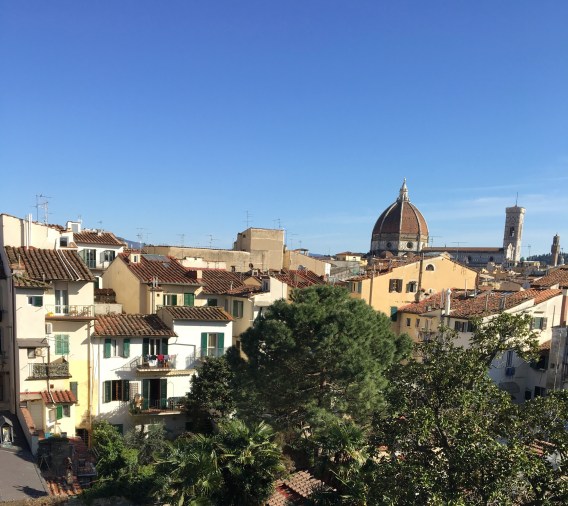
Florence is a city rich in cultural history, art and beauty. The acclaimed Duomo dominates the skyline from all angles, and the terracotta-coloured tiles on the roofs absorb the sun creating a warm, orange-ish hue that envelops the city. The streets are reminiscent of Venice: small, cobbled and crowded; and they all appear to lead to the main Piazza. Food in Florence is typically Tuscan and generally wonderful, a restaurant to highlight is ‘Fuoco Matto’, just off of Piazza Indipendenza. This is a modern, but relaxed, restaurant with a chilled vibe but traditional (and excellent) Tuscan food.
This itinerary includes the ‘must-sees’ of the city, but it is tailored towards the art-lover. The art is the primary reason we decided to visit Florence, and we were certainly not disappointed. This is a busy itinerary, and the days do tend to be quite full, but it ensures that key parts of the city are visited, and all the important pieces of art and architecture are included. Having said this, this itinerary is flexible, and allows time to break in the day and relax in the evening. There is also the possibility to re-arrange parts of the day to whatever suits best. This itinerary is not set in stone but offers a guide to the best places to explore on the same day. Comments are always welcome.
Day One:
- Fly into Rome
- Take the train to Florence
- Arrive at the hotel. Enjoy the pool, atmosphere and local surroundings.
We decided to fly into Rome primarily because the flights were cheaper, easier and available. Taking the train from Rome to Florence was clear and affordable. We bought first-class tickets for the same price as many UK standard tickets, and it was still rather luxurious. The journey itself was picturesque as we sped through the Tuscan countryside and enjoyed the views of Vineyards and farmland.
Day Two:
- Visit Galleria dell’Academia
- Walk to Piazza del Duomo
- Visit the Baptistry
- Visit Museo Dell’Opera di Santa Maria
- Have lunch in the area
- Visit Il Duomo de Firenze
It is essential to book in advance for the Galleria dell’Academia and it should be noted that the booking site is slightly difficult to navigate. Ensure enough time is left to book the tickets for the right day – they are non-refundable and non-transferable. Arriving at the Galleria at opening time would be good for those who wish to avoid masses of tourists and large tour groups. The Galleria holds Michelangelo’s legendary ‘David’ as well as multiple key medieval paintings, friezes and sculptures.
The Galleria is approximately a 9 minute walk from the Piazza del Duomo. Buying these tickets in advance is also helpful; the tickets cover the Museo Dell’Opera, the Baptistry and allows you to book a slot to clime the Brunelleschi Dome. To visit just the cathedral is free. It is important to check the opening/closing times of each location to decide the order in which to visit each location. We visited on a Sunday, and the Duomo was only open after 1:30pm, hence the decision to visit it last. The queue was long but moved quickly: do not be put off by it. There are plenty of cafés and restaurants in the square, and it is a beautiful place to soak up the sun and take in the glory of this architectural feat.


Day Three:
- Visit Leonardo da Vinci Museum
- Visit Capella de Medici, San Lorenzo Basilica and Medicea Laurenziana Library
- Walk to Piazza Santa Maria di Novella and have lunch in the area
- Visit Santa Maria di Novella
- Head back to the hotel for an afternoon/evening of relaxing
The Leonardo da Vinci Museum is a little-known gem of Florence. It is a small museum that maps the life and works of the famous artist and inventor. It also featured appliances and machinery built to-scale from da Vinci’s sketches, many of which are interactive. A great place for children and any physics/engineering/architecture lover.
The Medici Chapels and Library are only 5 minutes from the da Vinci museum and are a group of ‘must-sees’. The Medici Family were the prominent bankers, and ultimately rulers, of the city for a long period of its history. The Basilica and library are stunning in their medieval style, while the catacombs within the Medici household exhibit many of the jewels and treasures of the Medici collection.
Santa Maria di Novella is known for its beautiful facade that matches the exterior of the Duomo. Inside is a large chapel and series of cloisters that expand in a tardis style: the size of this church cannot be estimated from the outside.


Day Four:
- Visit Uffizi Gallery
- Walk up to Piazza della Signoria, take in the site and note Palazzo Vecchio
- Walk to Ponte Vecchio and over the bridge to Palazzo Pitti
- Have lunch in the area
- Visit the Palazzo Pitti
The Uffizi Gallery is the main art gallery in Florence. Again, booking in advance is recommended, unless you arrive early enough to queue. The gallery is arranged chronologically, and will take approximately two and half hours to see it all. The Uffizi houses key works by Michelangelo, Raphael, Da Vinci, Giotto, Botticelli, Bellini and Caravaggio. The Uffizi should be a priority for any art-lover or historian. Entrance to the Uffizi gallery also permits entrance to Palazzo Pitti and the Boboli gardens. It is possible to extend the tickets to cover three days to allow visiting flexibility.
Piazza della Signoria is around the corner from the Uffizi, and holds a selection of famous statues. The expansive nature of this square is impressive and the ability to admire the statues close up is a luxury not available in a museum setting. The placing of the statues in this public space creates a tangible connection between city and art that is somewhat lost when statues are enclosed in a gallery or exhibition.
Walking across the Ponte Vecchio provides scenic views of the River Arno as well as the opportunity to buy beautiful jewellery. The bridge is famous for its rows of jewellers, as well as for featuring in Puccini’s ‘O Mio Babbino Caro’. Palazzo Pitti holds a plethora of art and exhibitions, most notably the state rooms and the collection of “Modern Art” (Modern in this sense referring to post-1850).


Day Five:
- Hop on Hop off Bus Tour – first tour 9:00am, last tour 6:00pm
- Hop off at Santa Croce
- Get back on bus
- Hop off at Piazzale Michelangelo for the stunning views
- Get back on bus
- Hop off at Palazzo Pitti but walk around the Boboli Gardens + see the Neptune Fountain
- Hop back on and return home
I aim to use the ‘Hop on Hop Off Bus’ in each city I visit – it is a fantastic way to see the architectural sights and get a visual impression of the city as a whole. It also functions as an alternative to public transport, and it is easy to use and often tourist-friendly. The “Hop on Hop off” was brilliant in Florence as it allowed us to speedily visit Piazzale Michelangelo without taking half a day to climb the hill, as well as access the ancient town of Fiesole.
Santa Croce is another stunning church in Florence, comprising of this same, iconic facade design. This particular church houses the graves of Leonardo da Vinci, Michelangelo, Galileo Galilei and Machiavelli, as well as Cimabue’s infamous cross and a tunnel of Victorian graves. Piazzale Michelangelo offers panoramic views of the city and is a prime photo-taking location. We decided to alight the bus a stop early to walk through the Boboli Gardens, up to Palazzo Pitti. This is quite a steep climb but the lush greenery and manicured gardens are well worth the hike.


All pictures are my own unless otherwise credited. Permission must be obtained before any reproduction and credit must be issued in any reproduction.
 Under The Cypress Tree