
“Tidying up with Anna Price” – join me as I talk you through my clear-out process inspired by the KonMari method.
Anna Price


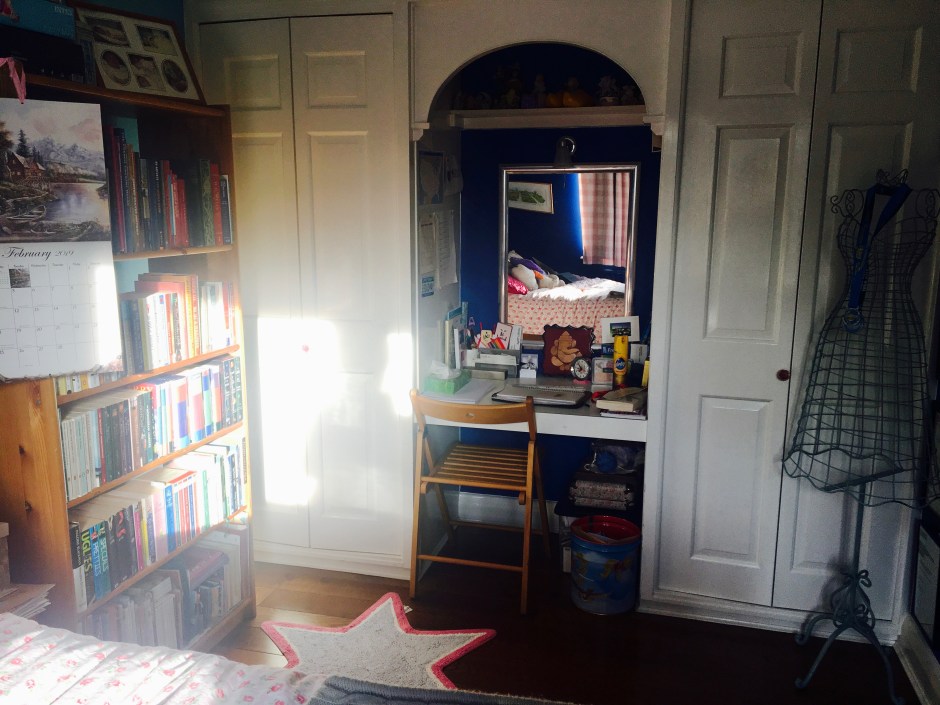
Returning to your childhood bedroom after university is overwhelming. Over the three, maybe four, years spent away from home, your bedroom remains a time-capsule of your teenage self. And upon returning home, two worlds collide. Possessions accumulated while in your student house (potted plants, cook books and display pillows) meet items of pre-teen angst (GCSE Science Revision books, Abercrombie track-suits and papier-mâché sculptures from Year 1). My bedroom was an explosion of my entire life and it perfectly encapsulated the graduate conundrum of living in your childhood room: not yet fully independent, but no longer a child. With no concrete graduate job on the horizon, and no prospects of moving out, I swiftly decided I could not live like this for long.
Inspired by Marie Kondo’s Netflix show ‘Tidying Up with Marie Kondo’, I look around the room and think ‘my god, what chaos’. KonMari aims to bring serenity and inspiration to the task of tidying, and to the tidy space. Marie categorises and prioritises where to start and is renowned for her question: ‘does it spark joy?’. I was taken with the fact she never criticises or shames her clients, and never judges what they decide to keep: it is a personal experience. I was inspired by this positivity. Nevertheless, I sentimental, I am a hoarder and I keep a lot of crap – the task ahead of me was monumental.


I remember which items were gifts for my 10th Birthday, where I bought those hideous, unworn, floral tights with my best friend when I was 14, and the excitement felt while wearing each dress for every 6th Form event and 18th Birthday. Due to this connection I somehow feel with each of my possessions, I decided to not follow each step of the KonMari method. If I held up every item and truly considered whether it sparked joy, nothing would ever get thrown out. I, therefore, came to the conclusion that I would go through everything, and pick up every item, and along with deciding whether it sparked joy, swiftly consider when I had last used it and if I would use it again. This way, I keep things that I love, but also that I will continue use/appreciate. I also decided not to thank each item for its service – the more I linger, the more I hold the object, the more likely I am to feel nostalgic and the more likely I am to keep it.
The KonMari method is founded on working by category, rather than tidying room by room. I settled on ignoring this, too. KonMari asks tidiers to start with their clothes, move onto books, papers, komono (miscellaneous), and finally, sentimental items. The issue I had was that I was only clearing out one room, and all of these categories were generally in and amongst each other in one big mess. I was impatient and I knew that sorting by category, I would not see progress quickly, as there would be ongoing clutter until the very end. I needed to see results otherwise I would give up. I decided, instead, to work methodically space by space, moving anti-clockwise around the room. I started with an easy section, my bedside table, and would end with my over-stuffed bookcase. This meant I saw progress with each day I worked at it, and slowly, my room became clear and peaceful.


What I did take from Marie, however, was her calmness and her positivity: I wanted to enjoy this process, I wanted to be mindful, introspective and forward-looking, as she advocates. I also resolved to fold my clothes according to her pattern, a method which is extraordinarily effective and that I now recommend to anyone and everyone. It substantially saves space, it renders your clothes effortless to access and it is easy to maintain. Ultimately, as Marie promotes, clearing out and tidying up is a very personal experience, and it is important that it is completed in a way that works for you.
The transformation my bedroom started to take was satisfying; by weeding through the overwhelming amount of clutter, the room was evolving into a space that is peaceful, colourful and happy. I decided to part ways with multiple art projects from primary school, and have boxed up some more beloved childhood items to carry with me to my next home. I finally donated clothes that are too small, and sifted through university papers and postcards. I discovered many physical photographs and mementos from bygone trips, that I am so grateful I kept and that have been put in a ‘project box’, along with birthday cards and letters.


I now know what is in every drawer, every shelf, and what lurks at the back of my wardrobe. Being this acutely aware of my surroundings is quite liberating. I am not haunted by physical unknowns in the deep, dark crevices of my bedroom. Bedrooms are often equated to people’s minds, and I have used the phrase ‘tidy room, tidy mind’ multiple times as a form of justifying procrastination-tidying – but only now do I fully comprehend it. Getting out of bed in the morning is less of a struggle, I feel happy emerge that little bit earlier to be able to drink coffee in bed, and enjoy the space. It is lighter, freer and calmer. Granted, my room is not ‘fully-adult’, it never will be. This will forever be my childhood bedroom; as long as I’m here it will have blue walls and stars on the ceiling. But, the chaos is abated and this room will now serve me just fine until I am ready to move on.
Head to my Instagram (annarose345) for more detailed pictures and stories on the clear-out process on my highlights.
Click here to learn more on The KonMari Method.
All pictures are my own unless otherwise credited. Permission must be obtained before any reproduction and credit must be issued in any reproduction.


 Under The Cypress Tree