
As a Victorianist, I am passionate about Millais, Rossetti, Fildes, Ruskin, Turner and the likes. I love depictions of London, vast gothic landscapes and representations of poverty.
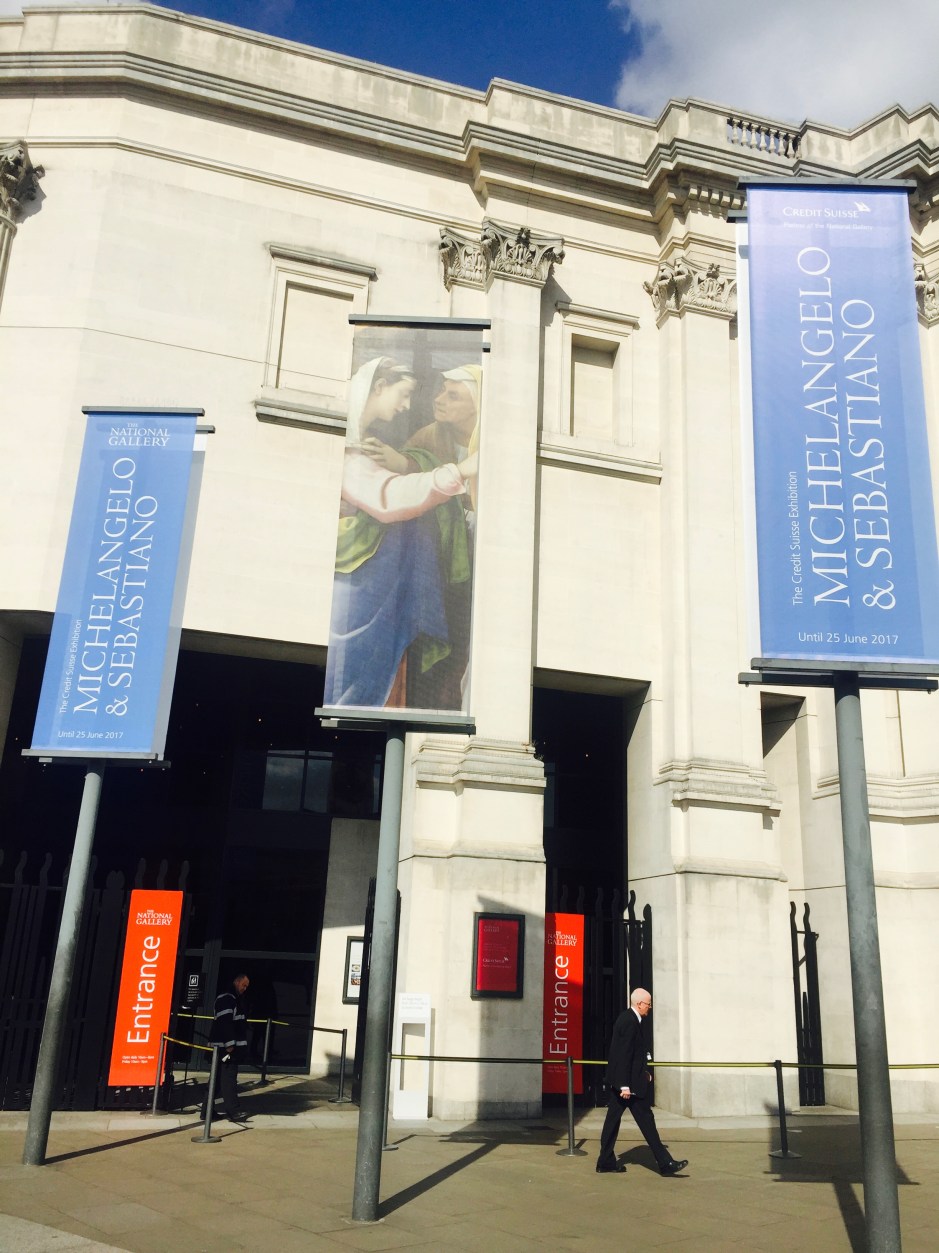
Little did I know that I would be so captivated by the National Gallery’s exhibit on Michelangelo & Sebastiano.
Michelangelo and Sebastiano were two of the most prolific artists of the Renaissance period. Meeting in Rome in 1511, an unlikely alliance emerged: forging the ground for an ‘epic and personal’ friendship and collaboration.
This exhibit at the National Gallery accumulates the artists’ best works and explores their collaborative relationship, mimicking styles and the development of their works of art. The exhibit also touches on Michelangelo’s intense rivalry with Raphael and the dialogue, in writing and in painting, between the two.


The most notable pieces of art for me, were the cast of Michelangelo’s ‘Pietà’ and Sebastiano’s ‘Lamentation over the Dead Christ’, which Michelangelo designed. The exhibit displayed a cast of Michelangelo’s sculpture, as the original is located in the Vatican Museums, Vatican City. The contemplation and reverence on the Virgin Mary’s face is intriguing, and contrasts to the many depictions of her anguish. There is an elegance created in the mother’s loss, yet the emotion is still intensified. This is mirrored in Sebastiano’s painting, as the Virgin Mary looks up to the heavens as her son lays at her feet. However, the separation of mother and son in this image isolates the Virgin in her grief as she is without the comfort of touch. It is explained by the National Gallery that this painting was hung in a chapel and that this position on the floor ‘made it look as if Christ was laid upon the alter, a clear reference to the rite of Eucharist’. The enlarged scale of the Virgin Mary in both depictions emphasises not only her purity and immaculate femininity, but also the importance of her position as mother of the church. In Sebastiano’s painting, the freely handled nocturnal background emphasises the colour and detailed depiction of the characters in the foreground creating a sensual feel to the painting.
Sebastiano’s ‘The Rising of Lazarus’ was also designed by Michelangelo. ‘The Rising of Lazarus’ reinstated the competitive rivalry between Michelangelo and Raphael. Cardinal Medici commissioned both ‘The Rising of Lazarus’ and ‘The Transfiguration’ (Raphael) in 1516. While the commission for ‘Lazarus’ was originally given to Michelangelo, it was later agreed that Sebastiano would take over. Sebastiano’s painting was completed and unofficially on view in 1518, by which point Raphael had not even started. By 1520, Raphael had almost finished, undertaking over 15 revisions, or pentimenti, of certain areas. He died, however, in April of that year and ‘The Transfiguration’ was displayed alongside ‘The Rising of Lazarus’ a week later.


The movement amongst the crowd in each image is particularly interesting – as in both paintings, arm gestures and body positions direct the eye to the focal image. The variety in reactions within the crowds aid this as they create a hub of emotion and dialogue that incites discussion amongst the observer. There is a flow of moment from within the paintings that extends out towards the audience. While Sebastiano’s interpretation of the ‘The Raising of Lazarus’ is fairly grounded and realistic, Raphael’s ‘The Transfiguration’ is etherial and angelic – the brightness of colour providing a holy glow to his depiction. I suppose the difference lies in the story behind each painting, but both still depict miraculous events. Lazarus is risen from the dead and is ready to live life again on earth, conversely, in the story of the Transfiguration, Jesus becomes a radiant glory, signifying the majesty of God and the celestial nature of Jesus’ presence.
Most interestingly, for each key piece of work displayed, there were multiple sketches and studies preparing for them. Their art was refined, detailed and practiced to perfection: there was little room for discrepancy and irregularity when the pressure of patronage and popularity was so great.
The exhibition was captivating and enlightening, educating the audience on the intricacies of the Michelangelo/Sebastiano relationship and their collaborative works. I am intrigued by the rivalry between Michelangelo and Raphael, and would love at some point to visit an exhibition on this: comparing the two’s work and understanding their differences.
 Under The Cypress Tree