Wild: A Journey from Lost to Found (Book Review)

A New York Times number one bestseller, Wild maps an autobiographical journey on the Pacific Crest Trail for self-acceptance, redemption and hope in order to tackle grief, loneliness and fear.

Cheryl Strayed loses her mother after a short but severe fight with cancer, contact with her close family dissipates and she separates from her husband and starts a downward spiral of drugs, sex and part-time waitressing. In need of an escape, and a means back to herself, Strayed takes on the PCT at the confusion of her close friends and with minimal training.

With boots too big, a “Monster” of a pack and the simple resolution to keep putting one foot in front of another, Strayed commences the trail and proceeds to trek through scorching 100 degree heat, vast terrains and stacks of compacted snow. Relationships are formed with inanimate objects: her pack, her tent, and her equipment become her comrades, while William Faulkner, Adrienne Rich, Flannery O’Connor, James Joyce and J.M. Coetzee offer companionship and support in her quest to keep moving forward. While she encounters snakes, bulls, a potential rapist and occasionally the other hiker, Strayed convinces herself that she is not afraid. She trains her mind to think that she is safe, and this in turn spurs her strength, perseverance and sense of belonging:

“Every time I heard a sound of unknown origin or felt something horrible cohering in my imagination, I pushed it away. I simply did not let myself become afraid. Fear begets fear. Power begets power. I willed myself to beget power” (p. 51).

While current meditation techniques encourage an acceptance of all thoughts and emotion, Strayed’s strength of mind to avoid fear and to convince herself that she is unafraid is empowering and poignant. Coinciding with Adrienne Rich’s poem: ‘Power’, there is a repetitive rhythm to the solitary nature of the trail, spurring Strayed’s self-encouragement, understanding and eventual self-affirmation.

This text is not afraid to divulge the challenges of the trail: the mental strain, the damage to the body (losing toenails and never-healing scars), the perpetual stickiness of sweat and matted hair. These elements are not glorified, and they are not appealing, but the sense of peace, accomplishment and primitive joy that emerges in snippets throughout the book are immense encouragements for the reader to get up, go out and enjoy the outdoors.
Screen Shot 2018-08-04 at 17.10.30
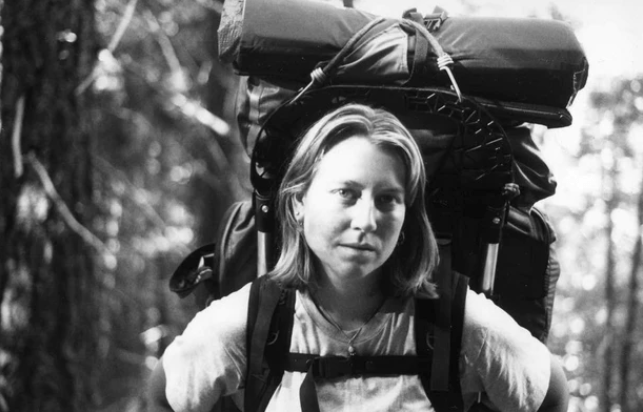
Cheryl Strayed on the PCT. Picture obtained from Cheryl Strayed’s Website.

Strayed’s unpreparedness for the trail is appealing to the average reader and allows for comedy as well as sympathy. Her mishaps, including her low average of 9 miles a day, render the text realistic and accessible, as they reveal her raw imperfections. This honesty draws in the reader and allows them to appreciate Strayed as a writer, as a trekker and as a woman. In spite of her adversities, however, Strayed is no stranger to nature: she grew up in rural Minnesota with a focus on freedom, living off the land and happiness. She has a knowledge of flowers and plants, and enjoys outdoor activities – a trait descended and ingrained from her mother. This love of nature is, after all, why she decided to return to it in order to find herself.

The description of Strayed’s epic quest runs alongside a counter-narrative that divulges stories from her childhood, the event of her mother’s illness and death, her relationships and infidelities and her dabbles with hard drug use. This counter-narrative, understandably, is not communicated chronologically; but it does provide a sense of confusion regarding the details of her past. The events leading up to Cheryl’s decision to hike the PCT, and then her preparation in advance of her actually starting the trail are obscured – there is a lack of clarity in the explanation of her preparation process, both mentally and physically. Then again, this is not a travel guide; it is a travel book. The important themes and motifs that arise in this segmented narrative are apparent and provide the reader with substantial information that allows them to understand Strayed’s character and her motives while on the trail.

Strayed’s novel is comedic and raw. The battle with bereavement is handled with honesty and care, while the quest for self-acceptance is empowering. The syntax is at times convoluted, but the language used is apt and the overall structuring works well. This book offered an escape from day to life, it was educative and inspiring: a fabulous must read.


All pictures are my own unless otherwise credited. Permission must be obtained before any reproduction and credit must be issued in any reproduction.

Wimbledon: How to Survive Manic Monday

Wimbledon occurs in the height of the British Summer Social Season: it is post Royal Ascot,  Chelsea Flower Show, Lords Test Matches and overlaps with Henley Regatta and this year’s England quest for the Football World Cup Trophy, but culminates pre-Proms. Wimbledon is the epitome of all-things British; strawberries and cream? Yes, please. Champagne and Pimms? Unquestionable. All-white sporting dress code? Love it. Freshly trimmed grass? Glorious. Highly sophisticated and civilised queuing system? What a time to be alive.

For the majority of people, the only way to obtain a ticket is to join ‘The Queue’ early in the morning and then wait in line to buy a grounds ticket (or if you’re early enough, tickets for Centre Court, Court One and Court Two). However, you may be lucky enough to have received a ticket in advance through various ballots and connections, meaning you can walk straight into the ground, grab some seats and soak up the atmosphere before play starts. This year, my friend and I were two of the lucky ones, and we decided to brace ourselves to attend on Manic Monday. This will be a guide on how to survive the crowds, the weather and enjoy the sport on this frenzied day.


Checklist: 

  • Liquids (Hydration is key. No-one wants play to stop because you’ve fainted)
  • Snacks (For when you’re riveted to a match and you don’t want to lose your seat, but you could do with a nibble)
  • Coolbag/Picnic (No better place to pause for lunch than on Henman Hill)
  • Umbrella + Mac (It’s England – you never know when the heavens will open)
  • Suncream (Again, unreliable English weather – no-one wants to look like a lobster)
  • Hat (The courts are uncovered and when the sun shines, it is really quite glaring)
  • Comfortable Shoes (Even if you do not wait in the queue, the grounds are quite big and walking is inevitable – I always think comfort is key in enjoying the day)
  • Patience (There will be lots of people, and multiple queues. It is unlikely you will be queuing for very long anywhere once in the grounds – stay patient and bear with it – it’ll be worth it)

Point of Arrival:

There are various carparks situated around the site, but driving can be a hassle in London, especially if the congestion charge applies. The best way to get there is by bus or tube. It is easily accessible from central London on the district line, or on the national rail service from Clapham Junction. If you get the tube, disembark at Southfields – it is a much shorter and direct walk to the main gate, passing the end of the queue on the way.


Plan of Action (for ticket holders):

  • Arrive in Southfields for 9:30am.
  • If you have not brought a picnic from home, pop by Sainsbury’s (on-route) and pick up some lunch food. Cafés inside the grounds tends to be expensive and over-priced, so picking up extra drinks, water and food now will ensure you’re prepared for the day.
  • Head on up to the main gate, proceed through bag check and head towards the Order of Play Board.
  • Figure out who you want to see play, the order in which they’re playing and the courts they’re on. Formulate an outline plan for the day – do not constrict yourselves to timings; you cannot predict the length of matches and therefore a certain amount of ‘winging-it’ must be applied for the day.
  • For reference, our plan was:
    • First Match: Ostapenko vs. Sasnovich (Court 3)
    • This was over at about 1:30 and we were then quite hungry, so headed to Henman hill for our picnic and to take in some Federer action on the big screen. We then re-filled water-bottles and wondered round the courts – enjoying some doubles and boys singles action.
    • We then re-queued to get back onto Court 3 – for which we needed to queue to obtain a ‘queue card’, which told us which gate to queue again at in order to get back onto the court. The efficiency and structure of this queuing system was so satisfying.
    • Third Match: Isner vs. Tsitsipas (Court 3).
    • Fourth Match: Clarke/Dart (GB Doubles Pair) vs. Mirnyi/Peschke (Court 3).
    • By this time it was 6:00pm, and feeling quite tired and thirsty, we decided to head home.
  • After having decided who you’re seeing first, head in the direction of that court and wait for the stewards to open the gates as you process (orderly, of course) to the classical music choice of that day.
  • You will probably arrive at your court before play begins, but obtaining a seat before queues form is good, take this time to chill-out and chat in the comfort of your seat. It is important to note in unreserved seating, you cannot save a seat while your partner pops to the toilet, and if you leave, you will have to re-queue to reenter.
  • Play the rest of the day by ear, depending on how you feel and who’s playing at the time!

Enjoying the Tennis

Watching the tennis is, inevitably, the most exciting part of the day, especially on Manic Monday. On this day, you have the ultimate tennis-enthusiasts and the fan-groups who have queued overnight – the atmosphere is fab and the tennis itself is at its highest standard. The stands are full, the shots are impressive, the serves are massive, and the competition is on. Families are routing for their players and the audience either picks a side or supports the game in general. Champagne corks are popping left right and centre, challenges provide anticipation while the gasps of the crowd provide a soundtrack to the matches. Cheers are loud, the suspense is strong and the emotional investment is evident. What’s not to love?!


All pictures are my own unless otherwise credited. Permission must be obtained before any reproduction and credit must be issued in any reproduction.