I am a “Southerner”. I enjoy the semi-seasonal weather, the clear dialect and afternoon tea in the garden. I generally do not feel infuriated by the individualist coldness on the London streets and I value the well-connected public transport links. For me, The Midlands and The North blur into one and they feature the scary myths of Spaghetti Junction, stand-still traffic on the M1, dinner at midday, chips and gravy, and scantily dressed girls on nights out. It is as foreign to me as The North is to the Lannisters. A crime, I know.
Needless to say, my venture to Yorkshire to visit my boyfriend’s family home, as well as the Brontë Parsonage Museum, was an educational adventure. After 4 hours driving northbound, we arrived in Pannel, a small town in the heart of Yorkshire County. The winter darkness had set in two hours into the journey, cloaking the vast, unruly countryside promised to me by so many writers. There was also no sense of crossing a boundary, nor a formal feeling of entering the north – we simply arrived. While it wasn’t raining, the bracing February wind was fiercely cold as it lashed our exposed skin as we raced into the warmth.
Our itinerary for the weekend was busy, exploring the cobbled streets of local towns and cities, tasting “Northern” fish and chips (and scraps), taking Betty’s Afternoon Tea, and, most excitingly, visiting the Brontë Parsonage Museum in Haworth. I am a Brontë enthusiast: Jane Eyre taught me to be strong and resolute, The Tenant of Wildfell Hall encouraged me to be independent and Wuthering Heights introduced me to a world of wild passion and expansive emotion. These iconic texts not only caused trembles in the patriarchal world of Victorian authors, but they also continue to shape and encourage young minds in this modern world. They offer an essential insight into the constraints of Victorian society, the issues revolving around the married/creative/emotional woman. While these novels are steeped in epochal issues, they are timeless in their impact as they continue to promote equality.
On approaching Haworth, the scenery is breathtaking. The expansive rolling moors, divided only by the rustic stone dykes, and the crepuscular rays illuminating sections of the green grassland, elicit a solitary, but liberating feel.
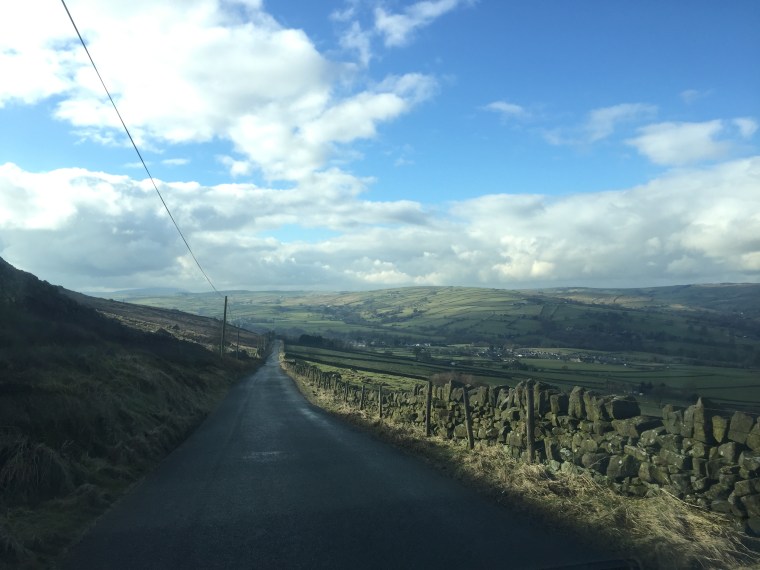
Elizabeth Gaskell traversed this same Yorkshire terrain and explains in her biography of Charlotte Brontë that ‘all round the horizon there is this same line of sinuous wave-like hills, the scoops into which they fall only revealing other hills beyond, of similar colour and shape, crowned with wild bleak moors – grand from the ideas of solitude and loneliness which they suggest’. Gaskell perfectly depicts the rise and fall of the horizon and captures the vast, expansive nature of this countryside. Gaskell also comments on the ‘solitude and loneliness’ of these moors. While the clear lack of people does support this sense of isolation, it is not lonely. It is, instead, peaceful, serene and glorious. By no means do these Yorkshire moors live to their bleak and grim reputation in the South; the epithet of ‘God’s Own Country’ is certainly spot on.
Scenery, setting and description is synonymous within Emily’s Wuthering Heights, as the untamed moors emulate Heathcliff’s primitive nature and Cathy’s impulsive emotions. While Emily illustrates the moorland and Yorkshire countryside in such an evocative manor in her text, physically being elevated in the depths of the hills, encircled by the bitter (but invigorating) wind, provides a connection to Emily, to the text and to Cathy that was quite unexpected. I was half anticipating to see the ghosts of Heathcliff and Cathy wandering the moors.
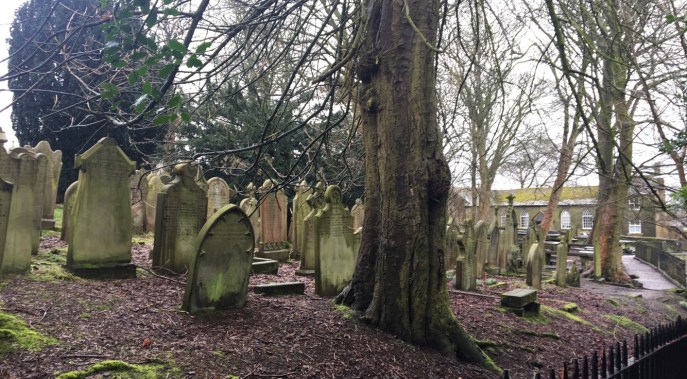
Entering the site just the two of us through the bottom of the graveyard, the atmosphere is incredibly suggestive as the tall evergreens somewhat block the light, providing an eerie hue, while the skeletons of the trees tower over the graves and physically signify the corpses in the ground. These elements undoubtedly perpetrate the sensations of the supernatural – if I were a ghost-watcher, I am sure I would have have sensed a presence.
We first visited the church before heading up to the parsonage. The connection to the author was epitomised at this point, and my fangirling surfaced as I exclaimed to my boyfriend: ‘This is it! They lived here. They actually walked these paths, breathed in these rooms, and this is where they lay!”. When did I become such a stereotypical, fanatical tourist? I am somewhat ashamed to say that this excitement lasted the duration of our parsonage visit – indulging in the manuscripts, pouring over letters, marvelling at outfits and admiring the original set up of the house. While I was slightly disappointed by the few amount of original ‘Emily artefacts’ on show, I realised that this was probably due to her early death. Only three months after Branwell’s passing, Emily also died, aged only thirty. At the parsonage, death is omnipresent; not only does the house look over the cramped churchyard, the parsonage itself would have been dark, damp and dank, creating an environment that fosters disease and, ultimately, death. These sinister undertones are apparent at the very core of Wuthering Heights, as the bleak setting and tragic plot perpetrates the sense of loss and desolation that occurred on the doorstep of the parsonage.
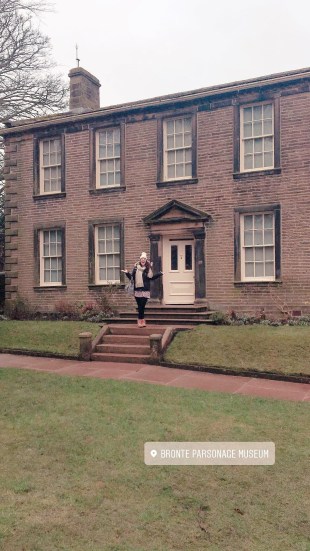
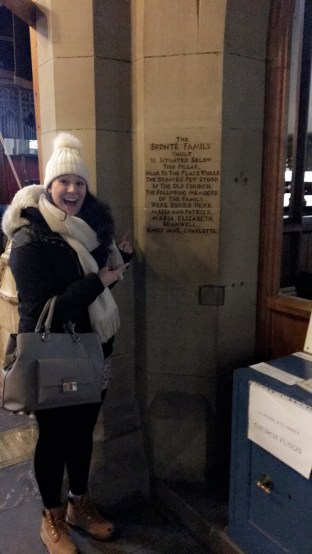
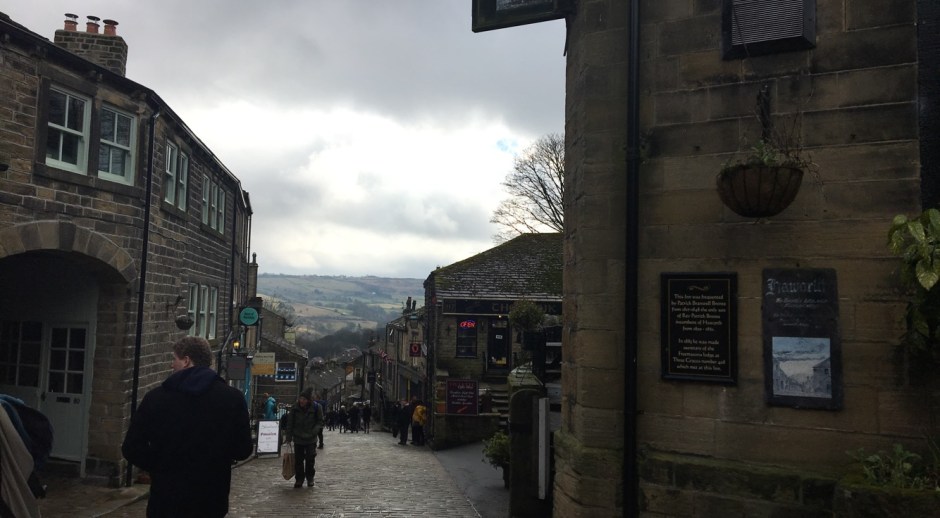
Despite this sinister atmosphere of the past, the present Howarth is charming. It allures the international tourist by its quintessentially British set-up, and pleases the seasoned British traveller with its shops, tea-rooms, pubs and sloping cobbled streets. After a warming cup of loaded hot chocolate, a plate of ploughman’s and conversation with the fellow tables we were fully satisfied. Brontë country had served us well.
My first trip “T’up North” taught me many things: that it is anything but bleak, that it may be cold but the sun does shine and that Northerners really are very friendly. It grounded my interest in the Brontë’s, their lifestyle and literature, and sparked an idea that has developed into my MA thesis. A second visit is now in the making, and I look forward to exploring more of this rich cultural heritage in the future!
All pictures are my own unless otherwise credited. Permission must be obtained before any reproduction and credit must be issued in any reproduction.
 Under The Cypress Tree